
If you are looking for the “holy grail” of countertop materials—the exotic beauty of marble combined with the legendary durability of granite—you are likely looking at Quartzite. This natural stone has surged in popularity for high-end kitchen remodels, offering a unique aesthetic that engineered materials simply cannot replicate.
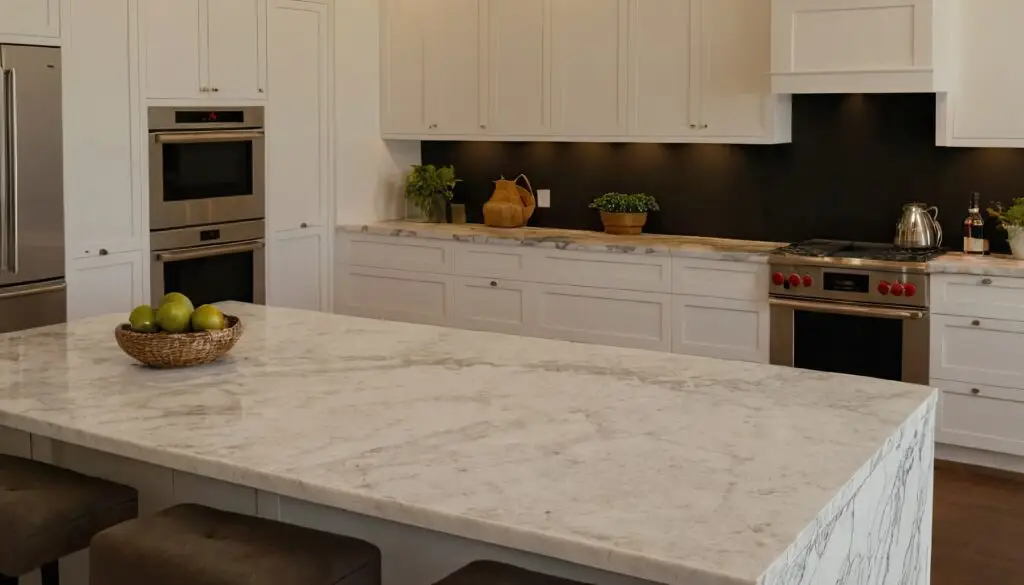
Quick Answer: Quartzite Is a Natural Stone Known for Strength and Veining
Unlike Quartz (which is man-made), Quartzite is a 100% natural metamorphic rock. It begins its life as sandstone and, through intense heat and pressure within the earth’s crust, the sand grains recrystallize into a dense, interlocking structure of quartz crystals.
Why it’s often chosen over marble for everyday kitchens
Marble is beloved for its soft veining, but it is notoriously “soft” and reactive to acids (etching). Quartzite offers that same elegant, high-movement look—often in whites, greys, and teals—but ranks significantly higher on the Mohs scale of mineral hardness. This makes it much more resistant to scratching and the wear-and-tear of a busy family kitchen.
Quartzite Pros and Cons
Pros: Heat resistance, natural beauty, long lifespan potential
- Heat Resistance: Unlike engineered quartz, which contains resins that can melt, quartzite is naturally heat-proof. You can generally place hot pans near it without fear of melting (though trivets are always recommended for any stone).
- Visual Depth: Every slab is a unique piece of art. The “depth” and translucency of the crystals in quartzite provide a three-dimensional look that printed engineered slabs lack.
- Extreme Hardness: It is harder than steel, meaning it is incredibly difficult to scratch with a kitchen knife.
Cons: Porosity, sealing needs, price variability
- Porosity: While hard, quartzite is still a natural stone with tiny pores. If left unsealed, it can absorb liquids, leading to deep-set stains.
- Sealing Needs: To maintain its beauty, it requires a periodic chemical sealer to block its pores.
- Price: Due to the difficulty of quarrying and the high wear-and-tear on fabrication tools (because the stone is so hard), quartzite is generally one of the more expensive countertop options.
Quartzite Care & Maintenance
Sealing schedule and spill strategy
To keep your quartzite pristine, it should be professionally sealed upon installation. For heavy-use kitchens, we recommend re-sealing once a year.
- The “Water Test”: Drop a small amount of water on the surface. If it beads up, your sealer is working. If it soaks in and darkens the stone within a few minutes, it is time to re-seal.
- Spill Strategy: Wipe up “reactive” liquids—like red wine, lemon juice, or beet juice—immediately. Even with a sealer, prolonged exposure to acids can eventually break down the barrier.
Safe cleaners and what to avoid
- DO Use: Warm water, mild dish soap, or dedicated pH-neutral stone cleaners.
- AVOID: Bleach, vinegar, ammonia, or abrasive “scrubbing” cleansers. These can strip the sealer and dull the natural polish of the crystals.
Quartzite vs. Granite vs. Quartz
| Feature | Quartzite (Natural) | Granite (Natural) | Quartz (Engineered) |
| Heat Resistance | Excellent | Excellent | Moderate (Resins can burn) |
| Maintenance | Annual Sealing | Annual Sealing | Zero Sealing |
| Scratch Resistance | Highest | High | High |
| Aesthetic | Exotic/Marble-like | Speckled/Grained | Uniform/Predictable |
Best for Heat: Quartzite or Granite.- Best for Low Maintenance: Engineered Quartz.
- Best for Natural Variation: Quartzite.
FAQs
Does quartzite need to be sealed?
Yes. Because it is a natural, porous material, sealing is the only way to prevent oil and water-based stains from penetrating the surface.
Can quartzite etch?
True Quartzite does not etch. However, some stones are sold as “Soft Quartzite” which may actually be a mix of minerals including calcite (which does etch). Always perform a “lemon test” on a sample of your specific slab to ensure it is 100% crystalline quartzite.
Is quartzite more expensive than granite?
Generally, yes. Quartzite is harder to find, harder to cut, and harder to polish than most granites. This increased labor and rarity usually result in a higher price point per square foot.
Experience the raw elegance of natural stone. Quartzite is a premium choice for those who refuse to compromise on either beauty or performance. At JRL Granite & Marble, we specialize in the delicate fabrication of these hard-as-diamond slabs.
Visit our showroom today to see our current inventory of exotic Quartzite slabs!