
In many urban office buildings, boutique clinics, and retail studios across the United States, space is at a premium. A small reception area does not mean a compromise in quality; rather, it requires a higher level of precision in design and material selection to ensure the space remains functional, welcoming, and professional.
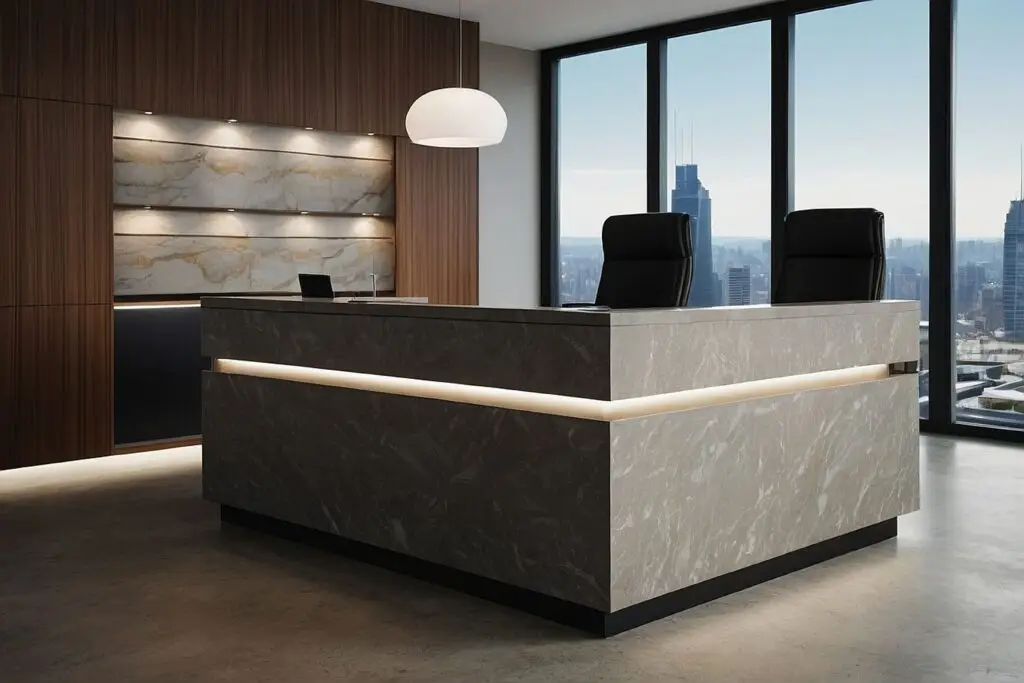
Quick Answer: Compact Counters Need Smart Layouts
For small reception areas, the goal is “Visual Lightness.” A compact counter must perform all the tasks of a large desk—housing tech, managing paperwork, and welcoming guests—without overwhelming the room. The most successful small counters use high-quality materials with slim profiles and integrated storage to keep the surface clutter-free.
Why size doesn’t limit professionalism
A smaller counter often allows for a higher budget-per-square-foot. This means you can opt for premium “Exotic” quartz or high-end natural stones that might be cost-prohibitive on a 20-foot desk. In a small space, every detail is visible, so the quality of the fabrication and the choice of stone become the primary indicators of your business’s prestige.
Best Materials for Small Reception Counters
Quartz Slabs
Quartz is ideal for small desks because it can be fabricated with very tight, nearly invisible seams.
- Consistent Patterns: In a small space, busy or large-scale patterns can feel chaotic. Choosing a quartz with a subtle “concrete” look or fine veining provides a sophisticated, modern backdrop that doesn’t “shrink” the room.
- Durability: Because guests are forced closer to the desk in small lobbies, the sides and corners are bumped more frequently. Quartz’s high impact resistance is a major asset here.
Solid Surface with Integrated Details
Solid surface (like Corian) is a secret weapon for small offices.
- Integrated Sinks or Trash Drops: If the reception desk also serves as a refreshment station, a solid surface can have a sink molded directly into the counter with no rim, saving precious counter inches.
- Translucency: Some solid surfaces can be backlit. In a small, dark lobby, a glowing reception desk acts as a light source and a design focal point simultaneously.
Light-Colored Stone to Open the Space
Standard design theory for American interiors suggests that lighter colors make small spaces feel larger.
- White Marble-Look Quartz: Materials like Calcutta Gold or Statuario styles provide a bright, airy feel.
- Reflective Finishes: A polished finish reflects light around the room, whereas a “honed” or matte finish absorbs it. For the smallest lobbies, a high-polish stone is almost always the better choice to create an illusion of depth.
Space-Saving Design Tips
Vertical Surfaces and Storage
When you can’t go wide, go vertical.
- The “Waterfall” Edge: Extending the countertop material down the sides of the desk to the floor creates a continuous loop. This “waterfall” effect draws the eye downward and makes the desk feel like a solid piece of sculpture rather than a piece of cluttered furniture.
- Recessed Plinths: Using a recessed base (kickplate) in a contrasting dark color can make the counter appear to “float,” which lightens the visual weight of the installation.
Clean Lines and Minimal Seams
In a compact counter, seams are highly visible.
- Single-Slab Construction: Most small reception desks (under 9 feet) can be cut from a single jumbo slab of stone. This eliminates seams entirely, providing a high-end, custom look that defines professional American office standards.
Common Mistakes to Avoid
Overly Thick Slabs
While the “thick slab” look (2 or 3 inches) is popular in luxury residential design, it can look bulky and “clunky” on a small commercial desk. A standard 2cm (3/4″) or 3cm (1 1/4″) profile is usually more proportional for small footprints. If you want a thick look, use a mitered apron to create the illusion of thickness without the actual weight.
Ignoring Staff Workflow
In a small desk, the “under-counter” area is tight. Designers often forget to account for:
- Cable Management: Ensure holes are pre-drilled in the stone for monitor arms and charging cables.
- ADA Knee Space: Even on a small desk, you must ensure that the accessible portion of the counter provides enough legroom underneath, which often limits where storage cabinets can be placed.
FAQs
What size should a small reception desk be?
A standard “small” reception desk is typically 48 to 72 inches wide. This provides enough room for one staff member and one guest interaction point while still fitting into a compact lobby or “elbow” office.
Can stone counters work in small spaces?
Absolutely. In fact, stone is often better than wood or laminate in small spaces because it is more resistant to the “scuffing” that happens when people move through tight corridors and brush against the desk corners.
Are custom counters worth it?
In small spaces, yes. “Off-the-shelf” furniture rarely accounts for the specific column locations or wall angles of a small office. A custom-fabricated stone counter allows you to maximize every square inch of your floor plan, often turning a “dead corner” into a functional workspace.
At JRL Granite & Marble, we believe that small spaces deserve big design. Our team specializes in custom-tailored solutions for boutique offices and specialized clinics across the United States. We handle everything from precision laser templating to the final polish, ensuring your small reception area meets all ADA requirements while making a world-class first impression. Transform your compact entryway into a statement of professional excellence.