
In the world of high-end kitchen design, precision is the difference between a standard room and a architectural Masterpiece. While many homeowners use the term “width” and “depth” interchangeably, understanding the horizontal span of your surfaces is critical for appliance compatibility and ergonomic flow. At JRL Granite & Marble, we provide the “Gold Standard” of technical guidance to ensure your stone is as functional as it is beautiful.
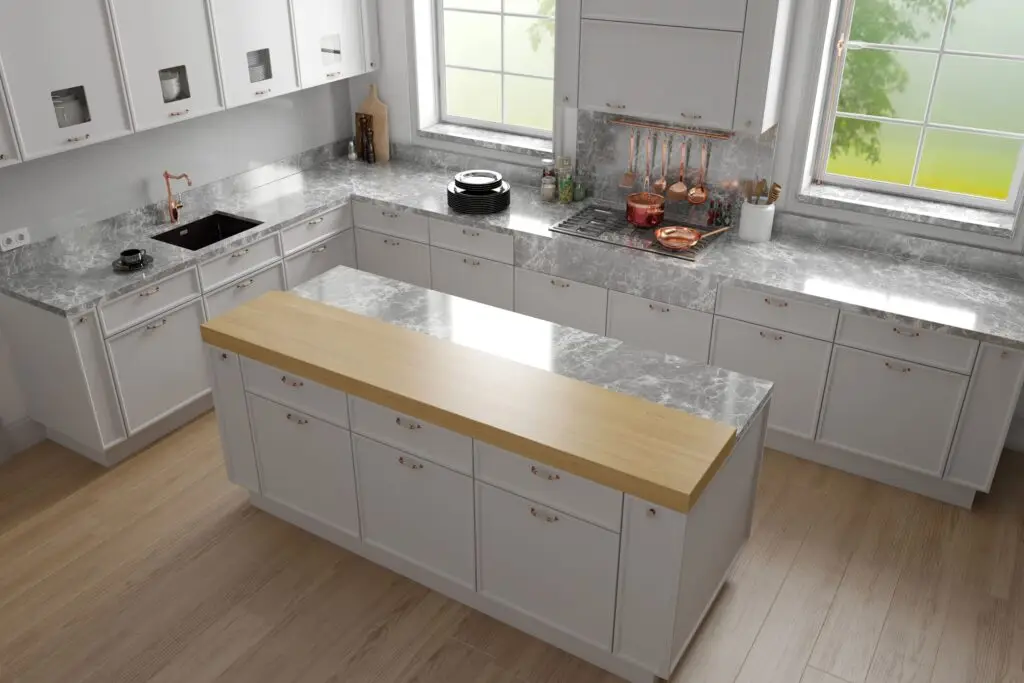
Quick Answer: Standard Countertops Are 25–26 Inches Wide
The standard width (depth) for a residential kitchen countertop is 25.5 inches (64.8 cm). This measurement is specifically engineered to cover a standard 24-inch deep base cabinet while providing a 1.5-inch overhang. This overhang is essential to protect your cabinet faces and hardware from spills while offering a comfortable “reach” for the user.
Standard Dimensions Explained: The Specialist Logic
To achieve a Masterpiece installation, specialists calculate width based on three specific structural components:
1. The Base Cabinet (24 Inches)
Almost all North American kitchen manufacturers build base cabinets to a standard depth of 24 inches. This provides enough space for plumbing, electrical runs, and standard-sized drawers.
2. The Standard Overhang (1.5 Inches)
The Gold Standard overhang is 1.5 inches beyond the cabinet frame.
- Protection: It ensures that liquid spills drop directly to the floor rather than trickling down the front of your cabinetry.
- Aesthetics: It provides a finished look that conceals the seam between the stone and the wood.
3. Appliance Alignment
Kitchen appliances like dishwashers and ranges are designed to sit flush with a 25-to-26-inch wide surface. If the countertop is too narrow, the appliance will protrude awkwardly; if it is too wide, the appliance controls may become difficult to reach.
Island Countertop Width: A Different Set of Rules
Kitchen islands are where custom craftsmanship truly becomes a Masterpiece. Unlike perimeter counters, island widths vary based on their intended use:
- Work-Only Islands: If the island is purely for food prep, a width of 24 to 36 inches is standard.
- Dining Islands (Seating): To accommodate seating comfortably, the width must increase. A Gold Standard dining island is typically 42 inches wide, allowing for a 12-inch to 15-inch “knee-space” overhang for stools.
- The Single-Slab Rule: Most natural stone slabs (Granite and Quartzite) are approximately 60 to 75 inches wide. When designing a massive island, specialists aim to keep the width within these limits to avoid visible seams, ensuring a seamless Masterpiece finish.
Custom Options: Tailoring the Width to Your Home
At JRL Granite & Marble, we often deviate from the 25.5-inch standard to solve specific design challenges:
- Extended Overhangs (Breakfast Bars): If you wish to add seating to a standard counter, we can extend the width to 36 or 42 inches. For any stone overhang exceeding 10 inches, our specialists will install hidden steel supports to maintain structural integrity.
- Slimline Counters (18–21 Inches): Ideal for “coffee stations” or narrow galley kitchens where floor space is at a premium.
- Commercial Widths (30 Inches): In professional-style home kitchens, wider counters are sometimes used to accommodate larger commercial ranges and provide more prep surface.
FAQ: Specialist Insights on Countertop Width
What is the difference between countertop width and depth?
In the stone industry, depth usually refers to the distance from the wall to the front edge (standardly 25.5″), while width (or length) refers to the distance from left to right along the wall. However, in casual conversation, “width” is often used to describe how far the counter sticks out from the wall.
How much overhang is too much for granite?
For a Masterpiece installation without support, the Gold Standard limit is 10 inches for 3cm stone. Anything beyond this requires brackets or corbels to prevent the stone from cracking or tipping under its own weight.
Does a 3cm stone change the required width?
No. Whether you choose 2cm or 3cm stone, the finished width remains 25.5 inches. The thickness of the stone only affects the vertical profile and the strength of the overhang, not the horizontal footprint on your cabinets.
Engineering Your Masterpiece with JRL Granite & Marble
A perfectly measured countertop is the hallmark of a professional kitchen. At JRL Granite & Marble, we utilize digital templating technology to ensure your stone matches the unique contours of your home with a Gold Standard level of precision. From standard perimeters to expansive, seamless islands, we bring artisan excellence to every inch of your surface.
- Stone Specialists: Expert guidance on Granite, Marble, and Quartz dimensions.
- Digital Precision: Laser-measured templates for a flawless fit.
- The JRL Standard: Engineering durability into every Masterpiece design.
Ready to measure your kitchen for a Gold Standard upgrade? Contact JRL Granite & Marble today for a specialist consultation and let us help you design the perfect dimensions for your Masterpiece home!