
Granite is one of the most durable materials available for American homes, but its strength is dependent on how it is supported. Unlike lightweight laminate, granite countertops weigh between 18 and 22 pounds per square foot. Installing them requires more than just adhesive; it requires a deep understanding of structural load, stone tension, and chemical bonding. In the high-end renovation market, the installation process is what determines whether your countertop will last for decades or develop stress fractures within the first year.
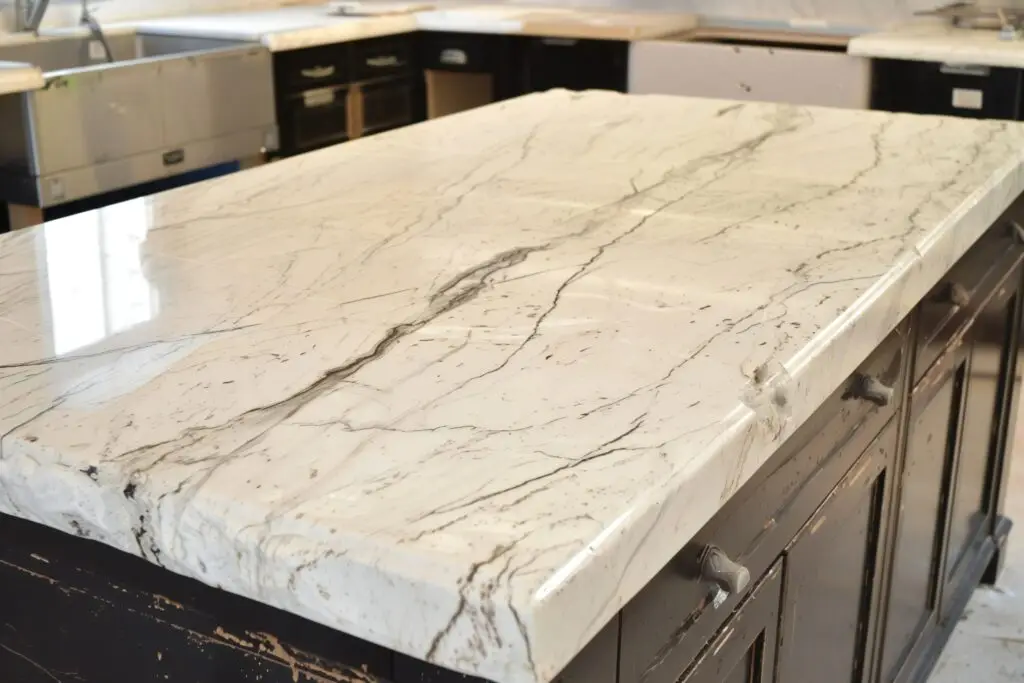
Quick Answer: Granite Installation Requires Precise Templating, Strong Support, and Careful Handling
A successful granite installation relies on a three-pillar process: Digital Templating to ensure a perfect fit against irregular walls, Cabinet Leveling to prevent stress points, and Professional Handling to avoid snapping the stone at its weakest points, such as sink cutouts.
Why granite installation is not like installing laminate
Laminate can be trimmed on-site with a circular saw and screwed into place from underneath. Granite is brittle, incredibly heavy, and must be cut with water-cooled diamond saws in a controlled fabrication facility. Once a granite slab arrives at your home, it is a finished product that cannot be easily “adjusted.”
Why most projects are better left to professionals
The risk of a DIY installation often outweighs the savings. If a $3,000 slab of granite cracks because it was carried horizontally instead of vertically, or if a seam is misaligned, the stone is usually a total loss. Professional installers carry the specialized equipment and insurance to guarantee a masterpiece result.
What Needs to Be Ready Before Granite Installation
Cabinets Must Be Level and Secure
Granite does not bend. If your cabinets are even 1/8-inch out of level across a 10-foot run, the stone will “bridge” the gap. Eventually, the weight of the stone or a heavy object placed on it will cause the granite to snap at that unsupported point.
Sink and Appliance Cutout Planning
Before the stone is even cut, the specific sink (undermount or drop-in) and cooktop must be on-site or their specifications provided. In 2026, many U.S. kitchens use oversized “farmhouse” sinks which require specific cabinet modifications before the granite can be placed.
Plywood Support Where Needed
While 3cm (1 1/4″) granite is standard in many regions and can often sit directly on cabinets, thinner 2cm granite usually requires a 5/8-inch plywood sub-top to provide the necessary structural base.
How Granite Countertops Are Installed
- Measure and Template the Space: A technician uses a laser scanner to create a digital map of your kitchen. This accounts for every wall curve and ensures the overhangs are consistent.
- Prepare Cabinets and Substrate: Installers check for levelness and apply shims where necessary. If a sub-top is required, it is secured to the cabinets now.
- Dry-Fit the Slabs: The granite is carefully brought in (always carried on its edge) and placed on the cabinets to ensure the laser template was accurate and the seams align perfectly.
- Secure the Granite in Place: A high-strength silicone or specialized stone adhesive is applied to the top of the cabinets to “bed” the stone.
- Join Seams and Finish Edges: For multi-piece runs, a two-part color-matched epoxy is used to join sections. A “seam setter” tool uses suction and tension to pull the pieces together for a nearly invisible joint.
- Seal if Needed: Once installed, the granite is cleaned with denatured alcohol and treated with a high-grade impregnating sealer to protect against stains.
Why DIY Granite Installation Is Risky
- Weight and Handling: A standard kitchen island slab can weigh over 400 lbs. Without a 4-to-5 person crew or specialized mechanical lifts, injury to the installers or damage to the home is highly likely.
- Breakage Risk Around Cutouts: The thin strips of stone in front of the sink are the most fragile. Professionals use “sink rails” or internal steel rodding to prevent these from snapping during transport.
- Precision Needed for Seams: Achieving a flat, tight, and color-matched seam is an art form. DIY seams are often wide, rough, and prone to collecting bacteria.
DIY vs. Professional Granite Countertop Installation
| Feature | DIY Installation | Professional Installation |
| Tools Required | Significant investment in stone lifters, diamond polishers. | All specialized equipment included. |
| Risk | You are responsible for any cracks or measurement errors. | Full warranty and insurance coverage. |
| Finish Quality | Seams and edges may look “handmade.” | Flawless, factory-polished edges and invisible seams. |
| Time | Can take multiple weekends of labor. | Usually completed in 4 to 6 hours on-site. |
How Long Does Granite Installation Take?
- Templating Timeline: Usually takes 1 to 2 hours at your home.
- Fabrication Timeline: The “waiting period” is typically 7 to 14 days while the stone is cut and polished at the shop.
- Install-Day Expectations: For an average-sized kitchen, the actual installation takes between 3 and 6 hours. You can usually use your new countertops (avoiding the seams) immediately, though the adhesive needs 24 hours to fully cure.
FAQ: Granite Installation Logic
Do cabinets need extra support for granite?
Usually, standard well-built cabinets can handle the weight of granite. However, if you have a large “overhang” for a breakfast bar (typically over 10 inches), you must install decorative or hidden steel brackets to support the weight.
Can I install granite countertops myself?
Unless you have experience in stone masonry and a team of strong assistants, it is not recommended. The cost of a single mistake exceeds the cost of professional installation.
Get Professional Granite Countertop Installation
At JRL Granite & Marble, we believe that a perfect slab deserves a perfect installation. Our expert teams utilize state-of-the-art laser templating and a refined installation protocol to ensure your granite fits like a glove and stays secure for a lifetime. We handle the heavy lifting, the technical seams, and the precision leveling, so all you have to do is enjoy your new masterpiece.
- Expert Laser Templating: Guaranteed precision for every angle and cutout.
- Professional Seam Joining: Nearly invisible joints for a continuous look.
- Masterpiece Craftsmanship: Licensed, insured, and experienced installers.
Would you like JRL Granite & Marble to provide a professional consultation and a detailed estimate for your granite countertop installation?