
Selecting surfaces for the hospitality sector requires a completely different calculus than residential design. In a hotel, a bathroom countertop must withstand hundreds of guests per year, constant exposure to chemical cleaners, and the potential for heavy impact or staining—all while maintaining a “brand new” appearance for the next check-in.
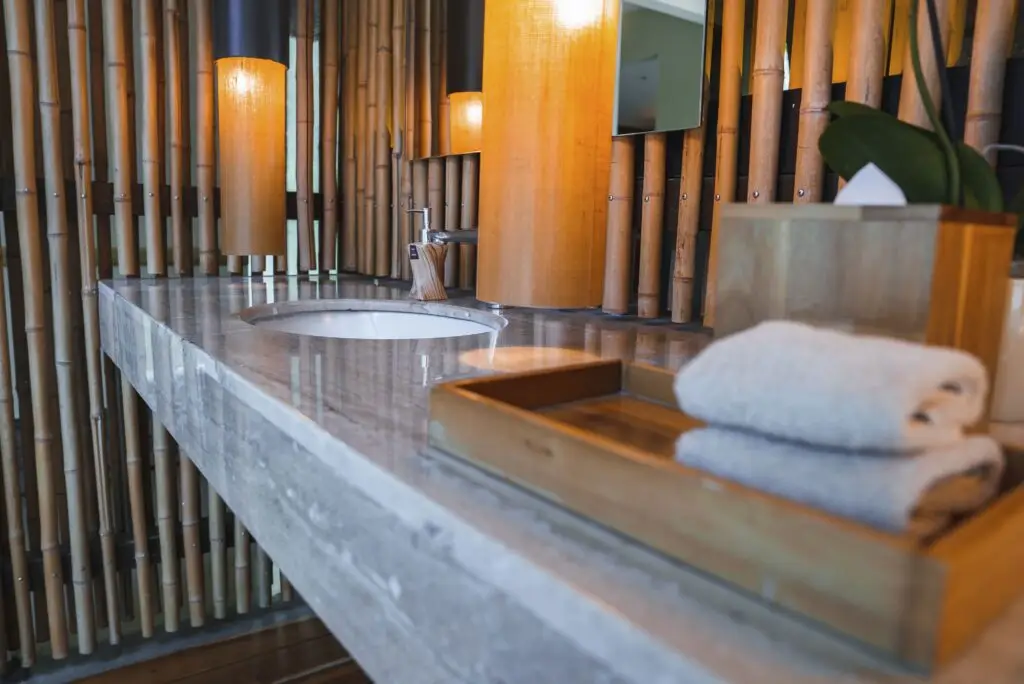
Quick Answer: Hotels Prioritize Durability, Hygiene, and Consistency
While a homeowner might choose a stone for its unique natural “veining” or “character,” hotel developers prioritize predictability. A hotel with 200 rooms needs 200 countertops that look identical and perform with zero failure. The primary goal is a surface that is non-porous (hygienic), resistant to harsh housekeeping chemicals, and difficult to chip or stain.
Why hotels choose different materials than homes
In a residential setting, a user might carefully wipe up a water spill or use a coaster. In a hotel, guests are less likely to be cautious. Surfaces are frequently subjected to wet towels left for hours, hot hair tools placed directly on the counter, and spilled toiletries like nail polish remover or high-pigment makeup. Hospitality materials are chosen specifically to survive these “worst-case scenarios.”
Best Countertop Materials for Hotel Bathrooms
Quartz (Uniform look, low maintenance)
Quartz is currently the gold standard for mid-to-high-tier US hotels (Marriott, Hilton, Hyatt).
- Consistency: Because it is engineered, every slab is identical, making it easy to replace a single room’s counter without it looking different from the rest of the floor.
- Non-Porous: It does not require sealing, which is a massive operational advantage for hotel maintenance teams.
Solid Surface (Repairable, seamless)
Materials like Corian are staples in the hospitality industry, particularly in mid-scale and economy brands.
- Seamless Integration: Sinks can be “thermal-bonded” to the countertop, eliminating the silicone joint where mold usually grows.
- Infinite Repairability: Unlike stone, if a guest burns a solid surface counter with a cigarette or hair iron, the mark can be sanded out and buffed back to its original finish on-site.
Porcelain Slabs
A growing trend in luxury boutique hotels, large-format porcelain offers the look of high-end marble without the fragility.
- Heat Resistance: Porcelain is virtually immune to damage from curling irons.
- Chemical Resistance: It is unaffected by the strong disinfectants used by housekeeping staff to meet modern sanitization standards.
Granite (Where sealing programs exist)
Granite is still found in many legacy luxury properties. While beautiful and durable, it requires a “sealing schedule” (usually every 12–24 months). If a hotel has a robust preventative maintenance team, granite offers a timeless, high-end feel that engineered products sometimes struggle to replicate.
Design & Operational Considerations
Integrated sinks and backsplashes
To maximize hygiene and minimize labor, many hotels opt for “coved” backsplashes (where the stone curves upward without a seam) and integrated or “undermount” sinks. This design prevents water from pooling in crevices, which reduces the likelihood of water damage to the vanity cabinet below.
Housekeeping-friendly finishes
“Polished” finishes are the most common in hotels because they are the easiest to wipe down. “Honed” or “leathered” finishes, while trendy in residential design, can be more difficult for housekeeping to clean quickly, as they may hold onto oils and fingerprints more stubbornly.
Cost vs Longevity in Hospitality Projects
Initial install vs lifecycle cost
A laminate countertop is the cheapest to install but may only last 3–5 years in a hotel environment before peeling or water-swelling occurs. Conversely, quartz or porcelain may cost three times as much upfront but can easily last 15–20 years (the typical “renovation cycle” for a hotel guestroom).
Replacement and repair logistics
In the hospitality industry, “Room Down Time” is lost revenue. Hotels prefer materials that can be repaired quickly or swapped out in a few hours without requiring a specialist to fly in or the room to be out of commission for days.
FAQs
Why do hotels use quartz countertops?
Hotels favor quartz because it offers the premium look of natural stone but is “housekeeping-proof.” It resists staining from wine, coffee, and makeup, and its non-porous nature makes it an excellent barrier against bacteria and viruses.
Are marble countertops practical in hotels?
Generally, no. Marble is highly porous and “etches” (loses its shine) when it touches acidic substances like lemon juice or certain soaps. In a high-traffic hotel, marble countertops would require constant professional polishing and sealing, making them a “maintenance nightmare.”
What countertops last longest in hospitality?
Quartz and high-quality Solid Surface typically have the longest lifespans. Solid surface wins on “repairability,” while quartz wins on “scratch and impact resistance.”
At JRL Granite & Marble, we specialize in high-volume hospitality solutions that balance aesthetics with bottom-line performance. We understand that in the hotel industry, a countertop is not just a design element—it’s a durable asset that must withstand the rigors of daily use and intensive cleaning. From boutique renovations to large-scale new builds, our team provides the expert fabrication and installation required to keep your rooms looking pristine check-in after check-in. Enhance your guest experience and protect your investment with the industry’s most reliable surfaces. Contact us today to discuss your project specifications.