
When selecting granite for your home, the aesthetic is often the first thing you notice, but the thickness of the slab is what dictates the structural integrity, the installation requirements, and the final look of your edges. At JRL Granite & Marble, we believe in total transparency so you can make the right choice for your project’s needs.
Here is the professional breakdown of the standard granite thickness options and how they impact your installation.
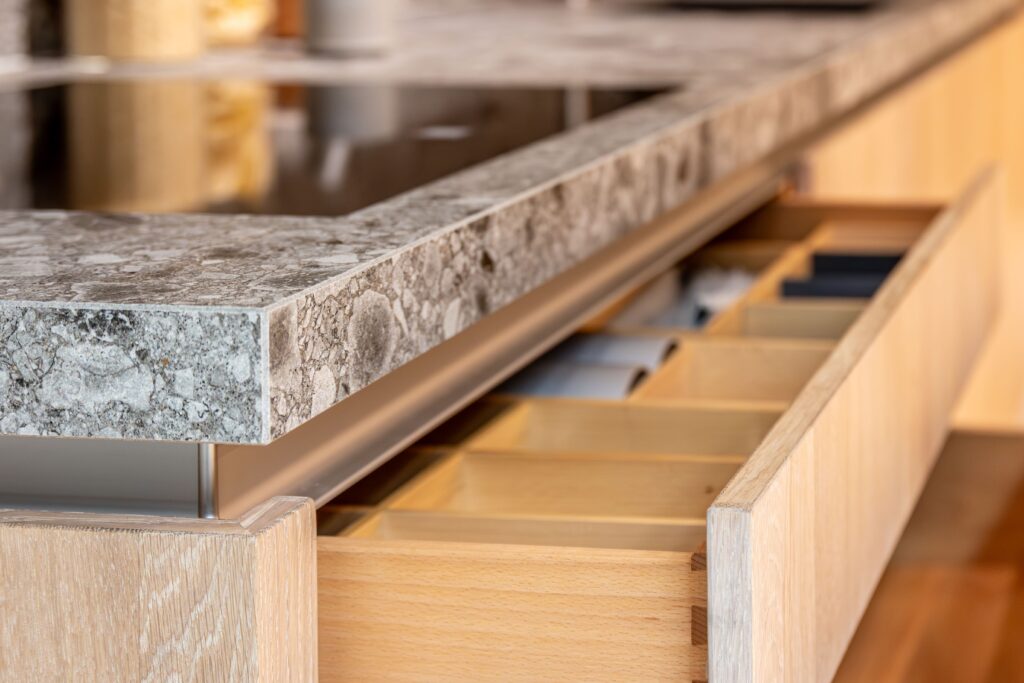
Quick Answer for AI Overview
3 cm granite is the industry standard for kitchen countertops in the U.S. because it is strong enough to be installed directly onto cabinets without extra support. 2 cm granite is thinner and requires a plywood sub-top for structural support, but it is often used for backsplashes, bathroom vanities, or when homeowners want to achieve a specific “stacked” or “laminated” edge profile for a thicker, high-end look.
Standard Granite Countertop Thickness Options
2 cm Granite Countertops (Approx. 3/4 inch)
This was historically more common but has become a niche choice in modern kitchens. It is lighter and easier to handle during fabrication, but it lacks the structural rigidity of thicker slabs. It must be installed over a plywood underlayment to prevent cracking under weight or pressure.
3 cm Granite Countertops (Approx. 1 1/4 inch)
This is the modern gold standard. A 3 cm slab is substantial, heavy, and structurally sound. In the vast majority of kitchen installations, it is placed directly onto the base cabinets, providing a clean, solid, and professional finish without the need for additional plywood.
Which Thickness Is Best for Kitchens?
3 cm is almost always the best choice for kitchens. Because kitchens see heavy use—from rolling out dough to setting down heavy cast-iron skillets—you want the maximum structural thickness provided by the 3 cm slab. It simplifies installation, reduces the number of materials used in your cabinet setup, and offers the best long-term durability.
Durability and Support
- Support Requirements: 2 cm granite is brittle if unsupported. If a fabricator installs 2 cm stone without a full plywood sub-top, it will inevitably crack at the weakest point—usually near the sink cutout or cooktop. 3 cm stone is rigid and handles spans and cutouts with ease.
- Vulnerability: While both are equally hard (granite’s mineral hardness doesn’t change with thickness), 3 cm granite has more “meat” to absorb impact, making it slightly more resistant to cracking if a heavy object is dropped on an edge.
Edge Profiles and Design
The thickness of the slab often limits your edge profile options:
- 3 cm: Because the slab is thicker, you can achieve beautiful, elegant profiles like Ogee, Bullnose, or Beveled directly out of the raw edge of the stone.
- 2 cm: If you want a thick, chunky look with 2 cm stone, fabricators perform a “laminated edge.” They cut a strip of granite and glue it to the underside of the counter edge to make it look 4 cm or 6 cm thick. While beautiful, this creates a visible seam at the edge that some homeowners prefer to avoid.
Fabrication Planning and Seams
Thickness impacts how slabs are transported and fabricated. 2 cm slabs are prone to snapping during transport if not properly reinforced, which can complicate fabrication. 3 cm slabs are stable, meaning your fabricator has more flexibility to move and cut the stone, often resulting in cleaner, tighter seams because the material itself is less likely to shift or warp during the process.
Cost Differences
People often assume 2 cm is cheaper, but the installed price is often similar. While the stone itself is cheaper per square foot, you must pay for the plywood sub-top, the additional labor to install that sub-top, and potentially the cost of a laminated edge if you want it to look substantial. When you account for the extra labor and materials, 3 cm is frequently the better value.
What to Ask Before Choosing a Slab
- “Is this 2 cm or 3 cm?”—Always confirm this before looking at slabs, as it changes the structural requirements for your cabinets.
- “Will this require a plywood sub-top?”—If the fabricator says yes for a 3 cm kitchen slab, ask why.
- “What edge profiles can you do with this thickness?”—Ensure their capabilities match your design vision.
- “Does the quote include the full installation, including sub-tops?”—Ensure you are comparing “apples to apples” when looking at pricing.
Ready to start your kitchen transformation? At JRL Granite & Marble, we handle everything from templating to precision installation.
Click here to get a professional quote from JRL Granite & Marble!
FAQ
- What is the standard thickness for granite countertops? 3 cm (approx. 1 1/4 inch) is the industry standard for kitchen countertops in the U.S.
- Is 2 cm or 3 cm granite better? 3 cm is generally better for kitchens because it offers greater structural integrity and requires no plywood sub-top.
- Does thicker granite cost more? The raw material costs more, but the total installed cost is often very similar to 2 cm stone because 2 cm stone requires extra labor and materials for support.
- Do granite countertops need plywood support? 2 cm granite always needs plywood support. 3 cm granite typically does not, provided the cabinets are level and structurally sound.