
Building an outdoor kitchen requires a different strategic approach than an indoor renovation. Exterior surfaces must withstand intense UV radiation, freeze-thaw cycles, and organic staining from leaves or pollen. Choosing the wrong material can lead to fading, cracking, or structural failure within just a few seasons.
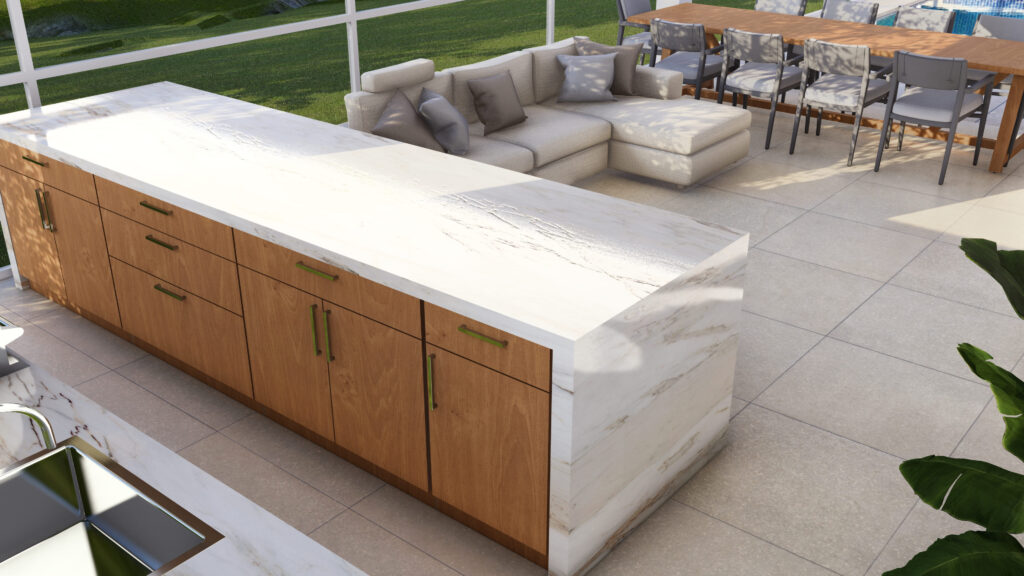
Quick Answer: Granite, Concrete, and Quartzite Are Best for Outdoors
For the best balance of longevity and aesthetics, natural stone and specialized masonry are the gold standards. Granite, concrete, and quartzite are the top choices because they are naturally resistant to heat and do not contain the petroleum-based resins found in many indoor-only materials that yellow and peel under the sun.
Best Materials for Outdoor Kitchens
1. Granite
Granite is arguably the most popular choice for outdoor countertops.
- UV Resistance: Unlike synthetic materials, granite’s color is baked in by the earth; it will not fade or “sunburn.”
- Durability: It handles high heat from grills and pizza ovens without scorching.
- Maintenance: When properly sealed, it resists mold and mildew. Design Tip: Opt for a “honed” (matte) finish rather than a polished one to reduce glare from the sun and hide water spots.
2. Concrete
Concrete offers a seamless, modern “industrial” look that fits perfectly in contemporary landscape designs.
- Customization: It can be cast in place to create unique shapes, integrated sinks, or “waterfall” edges.
- Thermal Mass: It stays relatively cool to the touch compared to dark stones.
- The Caveat: Concrete is prone to “spiderweb” hairline cracks over time as the ground shifts. While often considered character-adding, it requires a high-quality outdoor-grade sealer to prevent oil stains from outdoor cooking.
3. Quartzite
Not to be confused with “Quartz,” Quartzite is a natural metamorphic rock that is harder than granite.
- Luxury Aesthetics: It often features the elegant veining of marble but with much higher durability.
- Weatherproof: It is incredibly dense and non-porous, making it highly resistant to the expansion and contraction caused by extreme temperature swings.
- Investment: While more expensive than granite, its “forever” lifespan makes it a top choice for high-end luxury estates.
Materials to Avoid (Outdoor Red Flags)
Using the wrong material outdoors is a costly mistake. Avoid these three common pitfalls:
- Standard Quartz: Indoor quartz is roughly 7% to 10% resin (plastic). Under direct sunlight, this resin undergoes a chemical reaction that causes the slab to turn yellow, brittle, and eventually crack.
- Marble: While beautiful, marble is a “soft” stone. Outside, acid rain and organic debris (like bird droppings or fallen leaves) will “etch” the surface, leaving permanent dull spots.
- Recycled Glass: The binders used to hold the glass shards together are typically not UV-stable, and the glass itself can become dangerously hot in direct sunlight.
FAQ: Protecting Your Outdoor Investment
Do I need to cover my outdoor countertops in winter?
While the materials mentioned above are “best,” we still recommend using a breathable furniture cover during the off-season. This prevents water from pooling and freezing in the pores of the stone, which can lead to micro-cracks over many years.
What color is best for outdoor counters?
Light to medium tones (tans, greys, and light speckles) are superior for outdoors. Dark colors like “Absolute Black” granite absorb massive amounts of solar energy and can become hot enough to cause skin burns on a mid-summer afternoon.
How often should I seal outdoor granite?
Because the elements are harsher outdoors, you should seal your exterior granite once a year. A simple “water test”—sprinkling water on the surface to see if it beads up—will tell you if it’s time for a fresh coat.
Ready to Build Your Dream Outdoor Retreat?
Don’t let the elements ruin your investment. At JRL Granite & Marble, we specialize in sourcing and fabricating the world’s most resilient stones for the California climate.
Get a Free Quote for Your Outdoor Project Today!