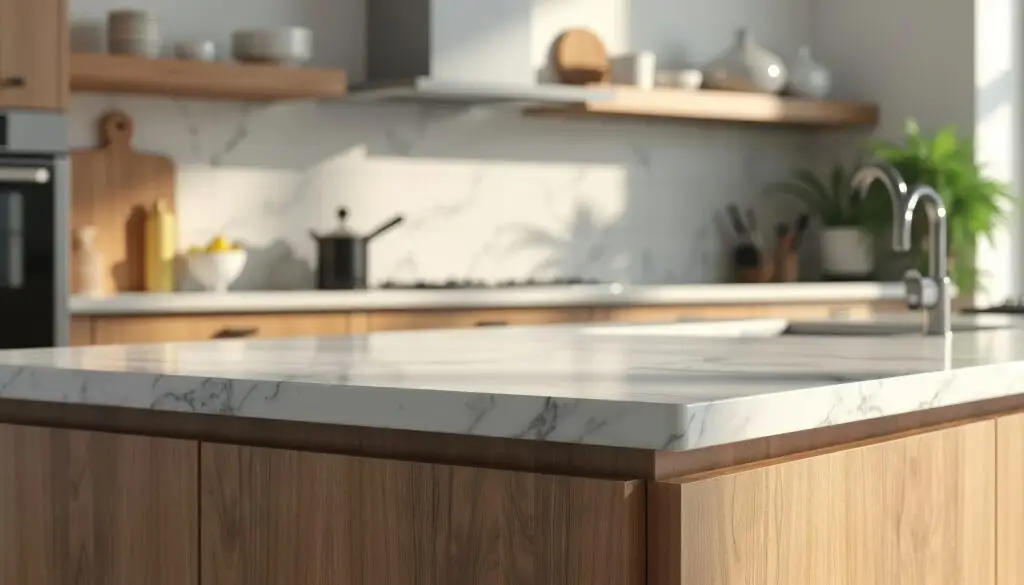
In the world of kitchen and bath design, the Eased Edge profile has risen to become the defining characteristic of modern simplicity. It is often the first choice for homeowners, designers, and builders looking for a clean, unassuming, and endlessly versatile finish for their stone or quartz slabs.
This guide dives into everything you need to know about the Eased Edge, from its subtle design to its immense practical benefits in contemporary American homes.
What Is an Eased Edge Countertop?
The Eased Edge is arguably the most straightforward and timeless edge profile available, serving as the benchmark against which all other profiles are measured.
Slightly Softened Square Edge
An Eased Edge takes a standard, sharp 90-degree square cut and softens the top corner with a very subtle radius. This rounding is usually minimal—typically a 1/8-inch or 1/4-inch radius—just enough to remove the sharpness without giving the appearance of a curved edge.
The result is a counter that maintains a strong, boxy, and monolithic appearance, making the stone look precisely as thick as it actually is, while being comfortable and safe to touch.
Difference Between Eased and Square Edge
While often used interchangeably in casual conversation, there is a technical and practical distinction between a perfect square edge and an eased edge:
| Feature | Eased Edge | Sharp Square Edge (sometimes called Straight) |
| Top Corner | A very slight, polished radius (rounded). | A precise, unrounded 90-degree angle. |
| Safety/Comfort | Safe and comfortable to lean against. | Can feel sharp and uncomfortable on the forearm. |
| Durability | Higher resistance to chipping on impact. | Highly prone to chipping upon minor impact. |
| Availability | The industry standard and default profile. | Typically avoided by fabricators due to high damage risk. |
In short: When you request a “Square Edge,” what you will nearly always receive from a professional fabricator is the safer, more durable, and standard Eased Edge.
Why Eased Edge Is So Popular
The Eased Edge’s widespread adoption stems from a powerful blend of aesthetic neutrality, practicality, and cost efficiency.
Clean, Modern Appearance
The Eased Edge is the visual partner of modern design principles:
- Monolithic Look: It allows the eye to focus entirely on the material’s color and veining, creating a single, solid block of stone. It avoids distraction, perfectly complementing flat-panel (slab) cabinetry and minimalist hardware.
- Visual Thickness: Unlike rounded edges (like the Bullnose) which visually “thin” the stone, the Eased Edge emphasizes the full depth of the slab, contributing to a substantial, luxurious feel.
- Versatility: Its simplicity ensures it will look harmonious whether the stone is a pure white quartz, a boldly veined marble, or a highly speckled granite.
Safer Than Sharp Square Edges
Safety is a prime benefit. While it looks square, the small rounding eliminates the razor-sharp corner that is present on a true 90-degree cut. This makes the countertop much safer for households with children and prevents accidental abrasions for anyone leaning against the counter.
Budget-Friendly Profile
For most reputable stone fabricators, the Eased Edge is considered the standard profile and is often included in the base price of the countertop material. It is the quickest and easiest edge to cut and polish, requiring less labor than complex profiles like the Ogee or Bevel. Choosing the Eased Edge is an easy way to reduce the overall cost of fabrication without compromising on style.
Best Applications for Eased Edge Countertops
Due to its universal appeal, the Eased Edge works well in virtually any setting, but it is particularly suited to certain applications and design styles.
Contemporary Kitchens
This is the Eased Edge’s natural habitat. It pairs perfectly with popular contemporary elements:
- Slab Doors: Cabinets with flat, unadorned doors demand the clean, perpendicular lines of the Eased Edge.
- Clean Geometry: It complements rectilinear elements like subway tile backsplashes, linear hardware pulls, and open shelving.
Bathrooms and Laundry Rooms
In smaller, high-use spaces, the Eased Edge offers maximum practicality. It is easy to clean, simple to fabricate for smaller vanity sizes, and its clean lines prevent the room from feeling visually cluttered. In a laundry room, it ensures the counter edge won’t catch clothing or fabric.
Waterfall Countertops
A Waterfall Edge is a feature where the countertop material continues vertically down the side of the cabinet, meeting the floor. The Eased Edge is essential for this design because it allows the stone to meet at the vertical and horizontal plane with the tightest, cleanest mitered seam possible, creating the illusion of one continuous block of material flowing downward. Any complex edge would interrupt this seamless appearance.
Eased Edge vs. Other Edge Profiles
When designers move away from the Eased Edge, it is usually to achieve a specific aesthetic or functional goal. Here’s how it compares to its main rivals:
Eased vs. Beveled
| Feature | Eased Edge | Beveled Edge |
| Shape | Squared appearance with a rounded top corner. | A flat 45-degree angle cut into the top edge. |
| Style | Minimalist, modern, and structural. | Transitional, sophisticated, and architectural. |
| Spills | Spills run straight down the cabinet face. | The bevel can help direct spills slightly away from the cabinet. |
| Visuals | Emphasizes the full thickness of the slab. | Creates a faceted, shadow line that can make the slab look thicker. |
The Beveled Edge introduces more visual complexity and shadow play, making it a better fit for traditional elements mixed with modern fixtures.
Eased vs. Bullnose
| Feature | Eased Edge | Full Bullnose Edge |
| Shape | Mostly square, minimal curve. | Fully rounded, resembling a half-circle. |
| Style | Modern, sharp, and structural. | Traditional, soft, and classic. |
| Safety | Safer than square. | Safest option, maximizes impact resistance. |
| Visuals | Emphasizes thickness. | Visually thins the stone, making it look lighter. |
The Bullnose is the perfect choice for highly traditional designs or settings where maximum physical safety (like a busy, central island) is the priority. However, its rounded shape is prone to sending liquids directly onto the cabinet fronts.
FAQs
Is eased edge durable?
Yes, the Eased Edge is highly durable. The slight rounding removes the brittle 90-degree point where stress concentrates. This radius distributes force when a heavy object is placed or dropped near the edge, making it significantly more resistant to chipping than a true, sharp square edge.
Does eased edge chip easily?
No more so than any other stone edge. While no stone is completely chip-proof, the Eased Edge is specifically designed to minimize chipping compared to the unrounded square edge. Any small chip that might occur is typically subtle and can often be repaired with a resin patch.
Is eased edge good for quartz countertops?
Absolutely, the Eased Edge is an excellent choice for quartz. Quartz is a manufactured material with uniform density, which allows fabricators to achieve extremely clean, crisp lines. Since quartz is the material of choice for modern designs, the Eased Edge is the most requested profile, complementing the material’s consistent pattern and color.