
The secret to a long-lasting stone installation is the 2/3 Cantilever Rule: at least two-thirds of your granite slab must be supported by a solid base, while no more than one-third should be overhanging. In 2026, industry standards from the Natural Stone Institute emphasize that any overhang exceeding specific limits requires mechanical reinforcement to prevent sagging or catastrophic failure.
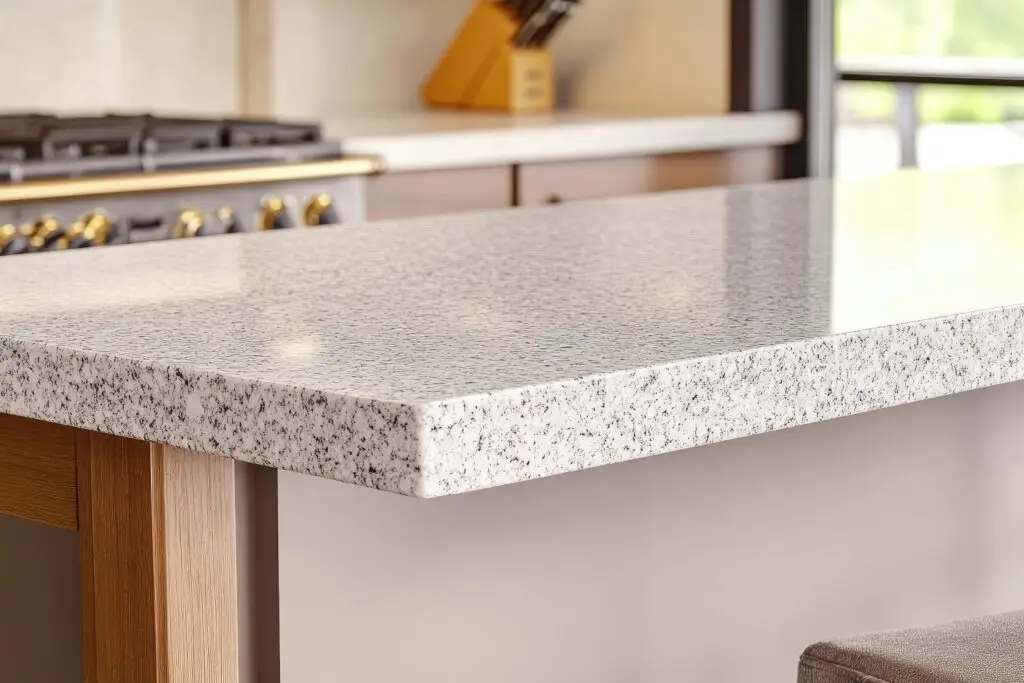
Quick Answer: Brackets Are Needed for Overhangs to Prevent Cracking
As a general specialist rule:
- 3cm Granite: Requires support if the overhang exceeds 10 inches.
- 2cm Granite: Requires support if the overhang exceeds 6 inches.
Failure to provide support beyond these limits places immense stress on the stone’s “fissures,” leading to cracks that cannot be simply buffed out.
When You Need Support Brackets
Kitchen Islands
Islands are the “Masterpiece” centerpieces of modern kitchens. Because they often feature large, uninterrupted slabs with seating on multiple sides, the weight distribution can be uneven. Brackets ensure that if a person leans or sits on the edge, the stone doesn’t act as a lever against the cabinet base.
Breakfast Bars and Knee Walls
When a countertop is mounted on a thin “pony wall” or knee wall, the narrow base provides very little surface area for bonding. Brackets are essential here to transfer the weight of the overhang directly into the vertical studs of the wall.
Overhangs Beyond 10–12 Inches
In 2026, deep seating areas are popular for “work-from-home” kitchen setups. If your design features a 12-inch, 15-inch, or 18-inch overhang, brackets are non-negotiable. For overhangs exceeding 24 inches, even brackets aren’t enough—you will likely need full structural legs or posts.
Types of Support Brackets
Hidden Brackets (The Modern Specialist Choice)
These are flat, heavy-duty steel plates that are routed into the top of the cabinet or knee wall.
- The Look: They are virtually invisible once the stone is laid, creating a “floating” effect.
- Advantage: They provide maximum legroom and a clean, minimalist aesthetic.
Decorative Corbels
Corbels are traditional L-shaped brackets that sit underneath the stone and attach to the face of the cabinet.
- The Look: Available in wood, wrought iron, or carved stone to match your kitchen’s style.
- Advantage: They serve as a design element while providing robust vertical support.
Steel “L” Brackets
Industrial-strength steel bars that offer a middle ground between hidden and decorative. These are often used in commercial settings or modern “industrial-chic” residential kitchens where the hardware is meant to be seen.
How to Choose the Right Bracket
- Measure the Overhang: Your bracket should extend to within 3 to 4 inches of the edge of the granite. If you have a 12-inch overhang, you need an 8 or 9-inch support arm.
- Calculate the Load: Granite weighs approximately 18 to 20 pounds per square foot. Ensure your brackets are rated for the total weight of the cantilevered section.
- Check the Material: In 2026, high-grade cold-rolled steel or stainless steel is the professional standard. Avoid flimsy aluminum or decorative plastic-core corbels for heavy stone.
Professional Installation Tips
- Spacing: Brackets should generally be spaced 18 to 24 inches apart. Start the first bracket no more than 6 inches from the end of the countertop.
- Routing for Flush Mount: For hidden brackets, a specialist will route a $1/2$-inch deep channel into the cabinet or wall. This ensures the stone sits perfectly flat on the base, preventing “teeter-tottering” that causes cracks.
- Anchoring: Brackets must be screwed directly into solid wood studs or the structural frame of the cabinet. Never anchor brackets solely into drywall or thin cabinet backing.
FAQ: Supporting Your Stone
Do I need brackets for Quartz?
While Quartz is more flexible than Granite, it still requires support. Most 3cm Quartz manufacturers recommend brackets for any overhang exceeding 12 inches.
Can I install brackets after the granite is in place?
It is significantly more difficult and less effective. Hidden brackets must be installed before the stone. If your stone is already installed, you are limited to using surface-mounted corbels or specialized “retro-fit” brackets.
Will brackets interfere with my knees when sitting?
Not if you use Hidden Brackets. By using low-profile steel supports that are only $1/2$-inch thick, you maintain a “Masterpiece” of comfort without sacrificing safety.
Protect Your Investment with Specialist Support
At JRL Granite & Marble, we don’t just sell stone; we provide structural peace of mind. Our team understands the technical requirements of high-end stone installation, ensuring your countertops are as safe as they are beautiful. From hidden steel supports to custom decorative corbels, we provide the “Masterpiece” engineering your home deserves.
- Structural Integrity Specialists: We follow all 2026 industry safety standards.
- Precision Installation: Routing and mounting for a perfectly flush finish.
- Custom Support Solutions: Tailored to your kitchen’s unique layout and style.
Don’t let your beautiful countertops be a safety risk. Contact JRL Granite & Marble today for a professional consultation on the best support system for your granite overhang!