
Quartz is an engineered stone made of approximately 90-93% ground natural quartz and 7-10% polymer resins. This composition makes it incredibly durable and non-porous, but it also makes the slabs exceptionally heavy—averaging 20 to 25 pounds per square foot for standard 3cm thickness. In the American home improvement market, the successful installation of quartz is defined by invisible seams, perfectly level surfaces, and structural integrity that prevents future cracking. Because quartz is more rigid than natural stone, it requires a foundation that is perfectly flat to avoid tension points.
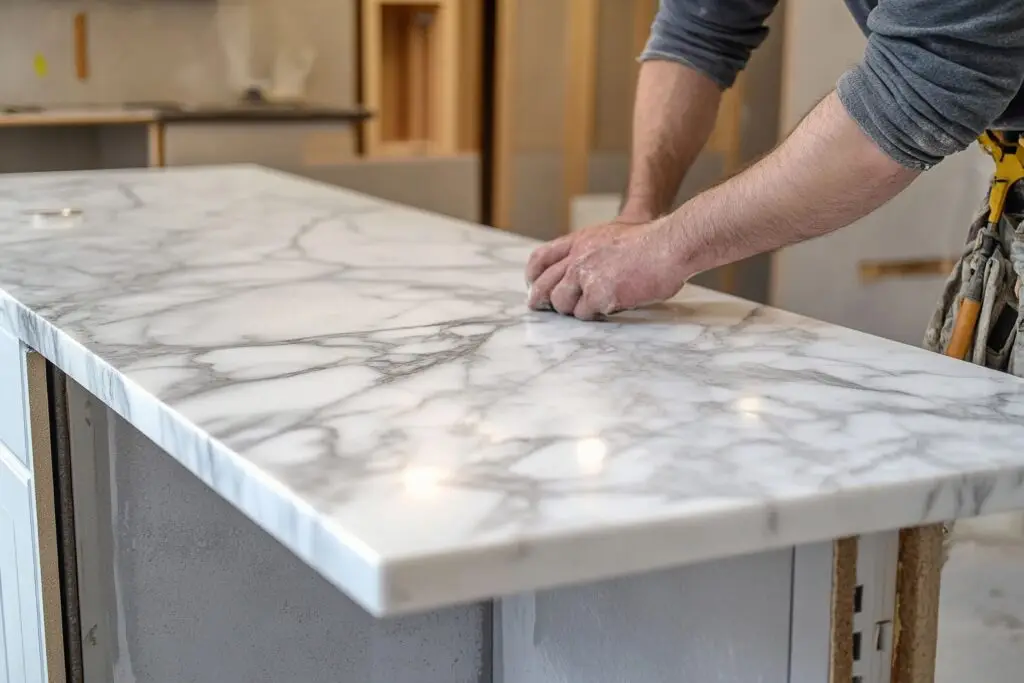
Quick Answer: Quartz Installation Requires Precise Measurement, Support, and Professional Tools
A successful quartz installation is not a single event but a multi-stage process involving digital laser templating, industrial-grade fabrication, and specialized suction-cup lifting equipment.
Why quartz is heavy and difficult to handle
A standard kitchen island slab of quartz can weigh well over 400 pounds. Unlike wood or laminate, quartz cannot be flexed or “forced” into place. If handled horizontally without proper support, the slab’s own weight can cause it to snap, especially around narrow cutouts like those for sinks or cooktops.
Why precision matters for seams and fit
Because quartz patterns are often consistent or intentionally veined (like Calacatta styles), any misalignment at the seams is immediately visible. Professionals use “seam setters”—vacuum-powered tools—to pull the two pieces together with thousands of pounds of force while the epoxy cures, ensuring a joint that is virtually invisible and smooth to the touch.
What Needs to Be Ready Before Installation
Cabinets Level and Secured
This is the most critical preparation step. Cabinets must be level within 1/8-inch over a 10-foot span. If the cabinets are uneven, the quartz will sit on “high points,” creating a bridge effect. Over time, the pressure from a heavy appliance or even leaning on the counter can cause the stone to fracture at the unsupported low point.
Sink and Appliance Planning
The specific sink model (undermount, drop-in, or farmhouse) must be on-site or its digital specifications provided before fabrication. Modern U.S. kitchen designs in 2026 often feature heavy cast-iron or composite sinks that require additional structural bracing within the cabinet before the countertop is laid.
Proper Support Structure
For islands or breakfast bars with an overhang exceeding 10 inches (for 3cm quartz) or 6 inches (for 2cm quartz), hidden steel brackets or decorative corbels must be installed. Quartz is strong, but an unsupported overhang is a major safety risk.
Step-by-Step: How Quartz Countertops Are Installed
Step 1 – Templating
Once your base cabinets are permanently installed, a technician uses a 3D laser scanner to create a digital “map” of your kitchen. This captures every wall irregularity and ensures the sink is perfectly centered.
Step 2 – Fabrication
The digital template is sent to a CNC (Computer Numerical Control) machine that cuts the quartz slab with water-cooled diamond blades. The edges are then polished to your chosen profile (Eased, Bullnose, Mitered, etc.) in a controlled shop environment.
Step 3 – Dry Fitting
The installers bring the pieces into your home and place them on the cabinets without adhesive. This “dry run” ensures that the overhangs are uniform and that the seams meet perfectly against the walls.
Step 4 – Securing Slabs
Once the fit is confirmed, a high-quality silicone adhesive is applied to the top of the cabinet frames. The quartz is lowered into place. The weight of the stone, combined with the silicone, keeps the slabs permanently anchored.
Step 5 – Seams and Finishing
If your layout requires a seam, a two-part color-matched epoxy is applied to the edges. Using a seam setter, the pieces are pulled together tightly. Once cured, any excess resin is scraped away with a razor blade, and the joint is cleaned with denatured alcohol.
DIY vs. Professional Quartz Installation
Risk of Damage
The most significant risk of DIY installation is breakage. If a quartz slab breaks during a DIY attempt, the homeowner is responsible for the full cost of a replacement slab. Professionals carry insurance and specialized “A-frame” transport racks to prevent these costly accidents.
Cost vs. Precision
While DIY might save on labor costs, the investment in specialized tools (diamond polishers, seam setters, heavy-duty suction handles) can quickly add up. Furthermore, a DIY seam rarely achieves the “invisible” quality that homeowners expect in a premium kitchen.
Why Professionals Are Recommended
Professional installers like JRL Granite & Marble provide a warranty on both the material and the labor. They ensure that the sink is properly supported and that the structural integrity of the entire kitchen is maintained according to U.S. building standards.
Common Mistakes
- Installing on Unlevel Cabinets: Leads to stress cracks and “rocking” slabs.
- Inadequate Overhang Support: Causes the stone to tip or break under weight.
- Using Permanent Construction Adhesive: If you ever need to remove the counters or cabinets, permanent adhesive will destroy both. Silicone is the professional standard as it allows for slight thermal expansion.
- Mismatched Seam Colors: Using a generic clear epoxy instead of a custom-tinted resin that matches the specific quartz slab.
FAQ: Quartz Installation Logic
Can you install quartz countertops yourself?
Technically yes, but it is highly discouraged due to the extreme weight, the need for specialized diamond tools, and the high cost of material loss if the stone cracks during handling.
Do quartz countertops need plywood support?
In the U.S., if you are using 3cm (1 1/4″) quartz, it can usually be installed directly onto the cabinets. If you are using 2cm (3/4″) quartz, a plywood sub-top is generally required to provide strength and to bring the height up to standard levels.
Get Professional Quartz Installation
At JRL Granite & Marble, we treat every quartz installation as the creation of a masterpiece. Our expert teams utilize advanced laser templating and precision fabrication to ensure your countertops fit perfectly, look stunning, and last a lifetime. We handle the heavy lifting and the technical details, providing you with a seamless experience and a flawless kitchen or bathroom.
- Digital Laser Templating: We ensure a perfect fit for every angle of your home.
- Invisible Seam Technology: Specialized tools for a continuous, high-end look.
- Masterpiece Craftsmanship: Licensed, insured, and dedicated to excellence.
[Would you like JRL Granite & Marble to provide a professional consultation and a detailed estimate for your quartz countertop installation?