
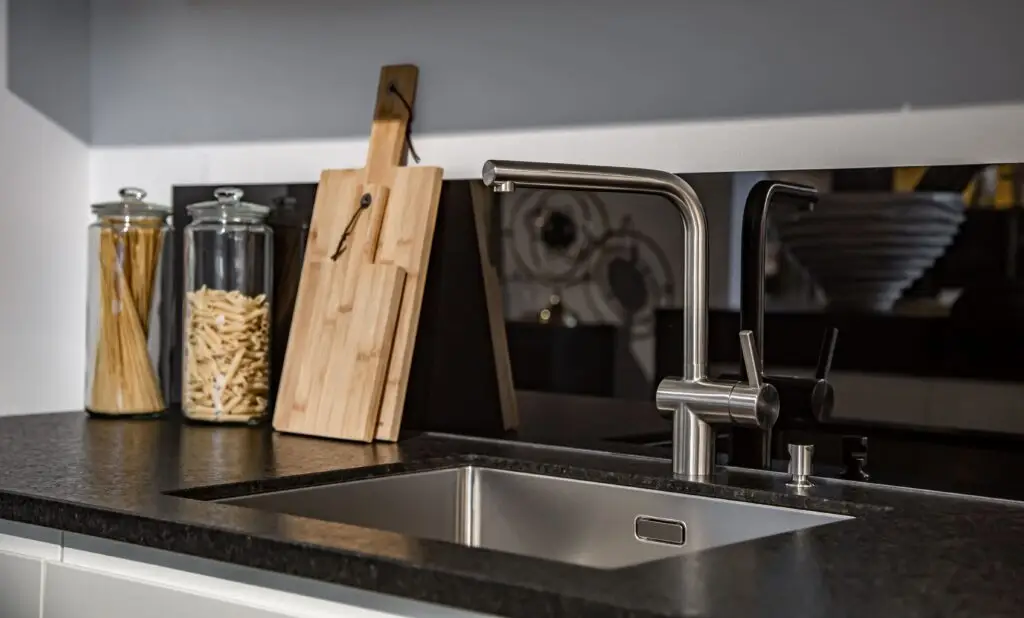
The sink cutout is the most vulnerable part of any granite installation. Because granite is a natural stone with inherent fissures, removing a large rectangular or oval section creates “stress risers” that can lead to structural failure if not handled with precision.
Why Sink Cutouts Are Vulnerable Areas
Stress concentration points
In physics, stress concentrates at corners. When a sink hole is cut, the sharp 90-degree angles (even if slightly rounded) become focal points for tension. If the house settles or the cabinets shift, the energy travels through the stone and seeks the weakest point—usually the narrow strips of granite in front of or behind the sink.
Improper support
Granite is incredibly strong under compression but weak under tension (pulling/bending). If the sink is under-mounted and filled with gallons of water and heavy cast-iron pans, that weight pulls directly on the stone. Without a “sink harness” or proper bracing to transfer that weight to the cabinets, the stone is likely to snap.
Common Sink Cutout Problems
Cracking around sink edges
These typically appear as hairline fractures starting at the corners of the cutout. They are often caused by “blown” rods (rusting steel reinforcement rods inside the stone) or thermal shock from pouring boiling water into a cold sink.
Chipping
The inner rim of a sink cutout is exposed to constant impact from heavy pots and pans. Because the edges are often “eased” rather than fully rounded, the sharp profile is prone to small “oyster-shell” chips over time.
Overcut openings
Inexperienced fabricators may accidentally cut the opening too large, leaving the granite rails too thin. If the front rail is less than 3 inches wide, it lacks the mass required to resist cracking during everyday use.
Structural weakness
Natural fissures—microscopic cracks formed over millions of years—can run through the cutout area. If the fabricator doesn’t identify these and reinforce them with fiberglass mesh or resin during production, the stone can fail during or after installation.
Can Granite Sink Cutout Cracks Be Repaired?
Epoxy repairs
For hairline cracks and chips, technicians use color-matched flowing epoxies or UV-cured resins. The adhesive is injected into the crack, polished flush, and buffed to match the surrounding stone’s sheen. When done correctly, the repair is nearly invisible.
Reinforcement methods
If a crack is structural, “stitching” may be required. This involves cutting a groove into the underside of the stone across the crack and embedding a carbon fiber or steel rod in epoxy to “bridge” the break and prevent further movement.
When replacement is required
If the crack has resulted in a “lippage” (where one side of the crack is higher than the other) or if the stone has shattered into multiple fragments, a repair will never be structurally sound. In these cases, replacing the slab is the only safe option.
How to Prevent Sink Cutout Damage
Proper support installation
Always use a mechanical sink-clip system or a “Cradle” support that attaches to the cabinet walls. Never rely solely on silicone adhesive to hold the weight of an undermount sink.
Avoid excessive weight
Do not stand on the countertop near the sink to reach high cabinets or change lightbulbs. The narrow strips of stone around the sink are not designed to support the concentrated weight of a human body.
Professional fabrication
Ensure your fabricator uses a CNC machine for precise radius corners rather than hand-cutting sharp angles, and ask if they use “rodding” (embedding reinforcement bars) for the sink area.
FAQs
Why did my granite crack near the sink?
The most common reason is moisture reaching the steel reinforcement rod (rodding) inside the stone, causing it to rust and expand. This expansion exerts “internal pressure,” forcing the granite to crack from the inside out.
Is it covered under warranty?
Most fabricator warranties cover “defects in material and workmanship” for 1 to 10 years. However, damage caused by standing on the counter or impact (chips) is usually considered “user negligence” and is not covered.
How much does repair cost?
In the US, professional granite repair typically ranges from $250 to $600, depending on the severity of the crack and the complexity of the color matching.
Granite Repair Specialists
Protect your investment by addressing small chips before they become large cracks. JRL Granite & Marble provides expert restoration services, including chip repair, crack stabilization, and professional re-sealing.
Seeing a crack near your sink? Don’t wait for it to get worse. Contact JRL Granite & Marble today for a professional evaluation and expert repair!