
Choosing your favorite slab of granite is an exciting milestone, but the journey from a raw stone block to a finished kitchen countertop involves a series of highly technical steps. Understanding the fabrication process ensures that you, the homeowner, are prepared for the timelines and decisions required to achieve a flawless result.
Quick Answer: Precision Templating + Layout Approval = Better Results
The secret to a high-end countertop installation isn’t just the stone; it’s the planning. Modern fabrication relies on precision measurements and a collaborative layout process.
Why templating is the foundation of fit and seam planning
Templating is the process of creating an exact 1:1 map of your cabinets. Because walls are rarely perfectly straight and cabinets can settle over time, a template captures every “scribe” (the curve of the wall) and determines exactly where the stone will meet the backsplash. This phase also determines seam placement. Strategic seam planning ensures that structural integrity is maintained (avoiding seams over dishwashers or near sink cutouts) while minimizing visual disruption.
What homeowners can approve before cutting (layout, seams)
You have the right to participate in a “Slab Layout” session. Since granite is a natural product with unique movement, you can choose which part of the slab becomes your island and which parts are relegated to less visible areas. This is also when you approve the “vein matching” at seams, ensuring the pattern flows logically from one piece to the next.
Step 1: Slab Selection and Inspection
Before a single cut is made, the slab must be vetted for quality and aesthetic suitability.
Color/vein variation and lighting checks
Granite can look vastly different under warehouse fluorescent lights versus the LED or natural light in your home. We recommend viewing slabs in person to inspect for:
- Fissures: Natural “cracks” that are part of the stone’s character but must be stable.
- Pitting: Small gaps between mineral crystals.
- Color Pools: Areas where minerals concentrated more heavily than others.
Step 2: Templating & Measurement
Once the cabinets are permanently installed and leveled, the fabrication team arrives to measure.
Digital vs. physical templates
- Physical (Luan/Plastic): The traditional method using strips of wood or plastic glued together to mimic the countertop shape.
- Digital (Laser/LT-2D3D): The industry standard in the U.S. A laser scanner captures the room’s dimensions with 1/16th-inch accuracy. These digital files are sent directly to the CNC machines, reducing the margin for human error.
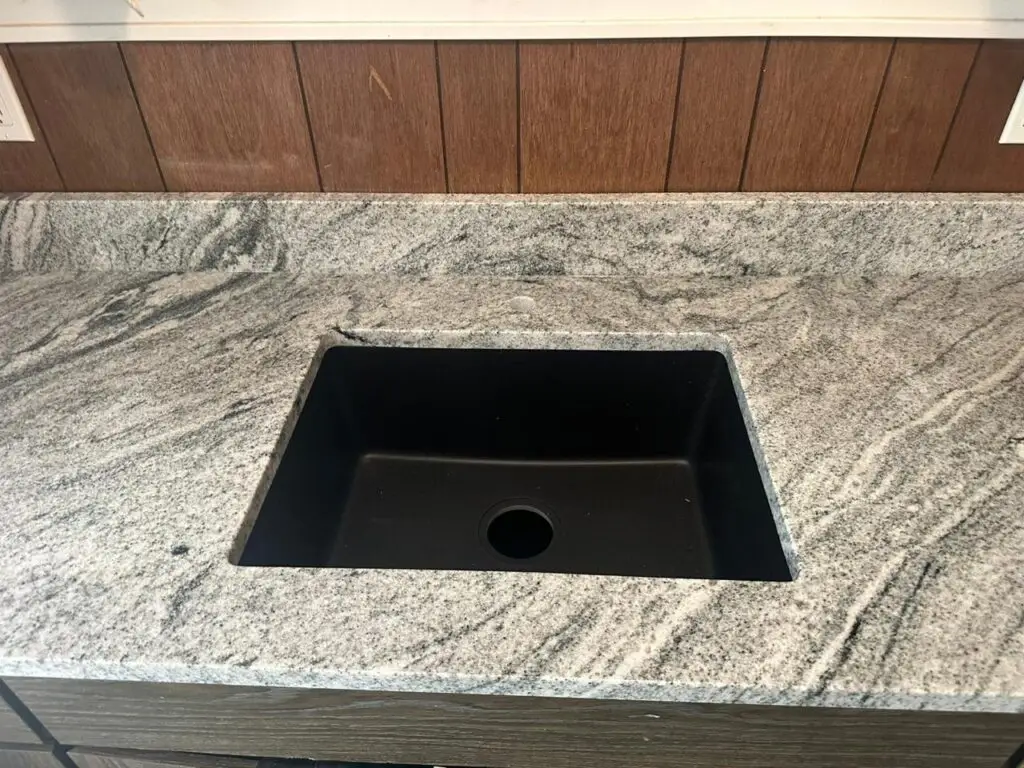
Sink, cooktop, and faucet cutout planning
During templating, the fabricator needs all appliance specifications. This includes the physical sink (to measure the “reveal”), the cooktop model, and the number of faucet holes required. These “cutouts” are programmed into the CAD file before fabrication begins.
Step 3: Cutting, Shaping & Edge Profiles
The raw slab is moved onto a massive saw bed to be transformed into your specific dimensions.
CNC and Waterjet basics
In professional U.S. shops, Bridge Saws or Waterjets are used for the primary cuts.
- CNC (Computer Numerical Control): This machine uses diamond-tipped tools to cut the stone based on the digital template.
- Waterjet: Uses high-pressure water mixed with garnet (an abrasive) to cut intricate shapes or tight radii that a circular blade cannot reach.
Common edges and where they work best
- Eased/Square: The most popular modern choice; clean, simple, and timeless.
- Bullnose: A fully rounded edge; safe for households with small children but can make the stone look slightly thinner.
- Ogee: A classic “S” shape curve; best for traditional or formal kitchen designs.
Step 4: Cutouts, Reinforcement & Polishing
Once the perimeter is cut, the details are refined.
Undermount sink reinforcement
Because stone is heavy and sinks full of water are heavier, we install “rodding.” These are high-strength steel or fiberglass rods embedded in the underside of the stone across thin areas (like the strips in front of and behind a sink) to prevent snapping during transport or installation.
Final polishing and finish options
The edges are polished using a series of diamond pads, moving from coarse to extremely fine grits until a factory-matching shine is achieved. You may choose between:
- Polished: High-gloss, reflective, and enhances the color of the stone.
- Honed: A matte, satin finish that hides fingerprints but requires more frequent sealing.
- Leathered: A textured finish that feels like orange peel; excellent for hiding crumbs and water spots.
Step 5: Installation & Final Sealing
The “Big Day” usually takes 3 to 6 hours depending on the size of the project.
Leveling, seams, and caulking expectations
Installers use “seam setters”—suction-based leveling tools—to pull pieces together. They fill the seam with a color-matched epoxy or polyester resin. Once dry, the seam should feel smooth to the touch, though it will always be visible to the eye. Finally, the stone is caulked where it meets the cabinets and walls to provide a water-tight seal.
Post-install care checklist
- Avoid Weight: Do not put heavy pressure on the seams for the first 24 hours while the epoxy cures.
- Initial Seal: We apply a professional-grade impregnating sealer immediately after installation.
- Cleaning: Use only stone-safe, pH-neutral cleaners moving forward.
FAQs
How long does granite fabrication take?
In the U.S. market, the standard lead time is typically 7 to 14 business days from the date of templating to the date of installation. This allows for layout approval, cutting, and hand-polishing.
Can fabricators reuse old countertops?
It is rarely recommended. Granite is cut to fit a specific cabinet layout. Removing old granite often results in breakage, and unless the new layout is identical to the old one, the seams and cutouts will not align.
How visible will seams be?
A professional seam should be less than 1/16th of an inch wide. While the epoxy is color-matched, the natural pattern of the stone will have a break. If you have a high-movement stone, the “disruption” in the pattern is what makes the seam noticeable, rather than the physical gap.
Are you ready to transform your kitchen with the permanence and prestige of natural stone? At JRL Granite & Marble, we combine old-world craftsmanship with the latest digital fabrication technology to ensure your investment lasts a lifetime.
Contact us today to schedule your precision template and start your kitchen transformation!