
Live edge countertops represent a bold departure from the standard, polished, rectilinear surfaces common in modern design. By embracing the organic contours of the material, they transform a functional surface into a singular piece of natural art. These statement pieces are gaining popularity in high-end, custom homes across the US, offering a blend of rustic charm and sophisticated contemporary design.
What Is a Live Edge Countertop?
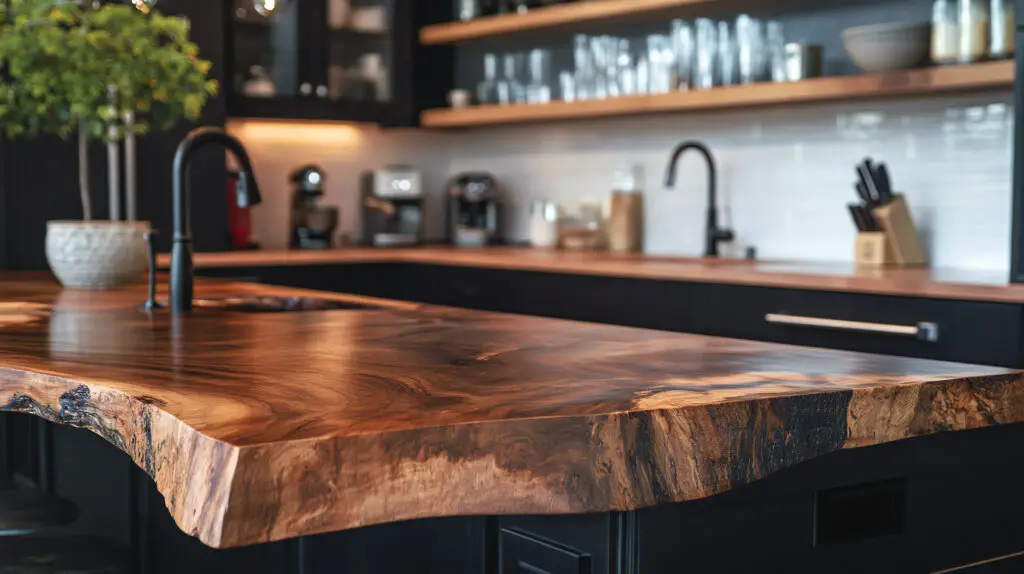
A live edge counter is defined by its retention of the material’s original, unaltered edge. Instead of being cut straight and polished into a specific profile (like Bullnose or Eased), the perimeter follows the natural growth or crystallization pattern of the slab.
Natural, Unfinished Edge Following Stone or Wood Shape
The key characteristic of a true live edge is the preservation of the material’s outer layer.
- Wood Live Edge: This is the most common interpretation. The edge of the countertop slab retains the natural curve of the tree trunk, often including the texture of the bark (though the bark itself is usually removed and the wood is sanded and sealed for stability). The shape is unique to that specific tree.
- Stone Live Edge: In stone (granite, quartzite), a live edge refers to leaving the slab’s natural, jagged, or crystalline boundary visible. While it must still be sealed and smoothed to prevent flaking and injury, it is not a uniform, fabricated shape. It often has a rugged, dimensional texture that mimics the natural cleavage of the rock.
Live Edge in Stone vs. Wood
While both materials can achieve a live edge look, the application and effect are very different:
| Feature | Wood Live Edge | Stone Live Edge |
| Material Origin | The perimeter of the tree trunk (cambium layer). | The naturally fractured edge of the quarried rock slab. |
| Texture | Smooth, undulating, and flowing curves. | Jagged, rough, crystalline, and three-dimensional. |
| Installation | Often thicker (2–3 inches), typically over lower cabinets or legs. | Usually standard 3cm thickness, often cantilevered or supported by metal brackets. |
| Aesthetic | Rustic, warm, organic, and mid-century modern. | Raw, rugged, geological, and highly dramatic. |
Materials Commonly Used for Live Edge Countertops
The nature of the live edge dictates that the material must be suitable for displaying its natural, irregular boundaries.
Quartzite and Granite Live Edge Slabs
Natural stone is an excellent medium for a live edge, particularly materials known for their hardness and crystalline structure.
- Quartzite: This highly durable stone is often a prime candidate. Its density allows for a rugged, yet strong, edge that can be honed and sealed without undue risk of structural failure. The unique mineral deposits and light-reflecting crystals in quartzite are beautifully showcased by the raw edge.
- Granite: Certain granite slabs that feature strong, prominent crystallization can be left with a fractured, live edge. This is typically achieved by breaking the edge along a natural fault line and then polishing the resulting irregular surface to smooth the jagged points while retaining the dimensionality. This creates a more controlled, rough-hewn look often called a “Chiseled” or “Rock Face” edge in the industry, which is the closest stone equivalent to a live edge.
Marble Live Edge Limitations
While visually stunning, marble is generally less suitable for a true structural live edge than granite or quartzite.
- Softness and Vulnerability: Marble is softer and more porous. Leaving a truly ragged, live edge increases its vulnerability to chipping, staining, and wear in a high-traffic kitchen environment.
- Aesthetic Preference: Marble’s primary aesthetic appeal is its elegant, flowing veining, which is typically best highlighted by smooth, polished edges like the Ogee or Eased profile. The contrast between marble’s inherent luxury and a raw, rugged edge can sometimes feel jarring or incomplete. If attempted, it is usually a very subtle, softly chiseled edge.
When Engineered Stone is Not Suitable
Engineered stones, such as quartz (a resin/quartz aggregate product) or porcelain slabs, are not suitable for true live edge applications.
- Manufactured Uniformity: These materials are manufactured for consistency and perfectly straight cuts. They lack the natural, internal veining or crystalline structure that would create a believable, geological live edge.
- Aesthetic Mismatch: The core appeal of engineered stone is its consistent color and pattern. A jagged edge would reveal the material’s manufactured composition, undermining the organic aesthetic that the live edge is meant to achieve.
Pros and Cons of Live Edge Countertops
Choosing a live edge requires weighing its dramatic visual impact against the practicalities of its irregular shape.
Unique Appearance and Statement Design
The primary motivation for choosing a live edge counter is the unparalleled visual effect it creates.
- Nature as Art: Each slab of wood or stone is unique, meaning a live edge counter is literally a one-of-a-kind piece of functional art. It showcases the natural history of the material, whether it’s the rings of a tree or the crystalline formation of a rock.
- Focal Point: These countertops inherently draw the eye and become the room’s undisputed focal point. They are particularly effective in open-concept spaces or industrial/rustic-modern designs, providing essential warmth and organic texture to balance clean lines and hard materials (like stainless steel or concrete).
- Customization: When working with a fabricator, you can often select the specific slab and even decide which side will retain the live edge, allowing for total control over the surface’s visual flow.
Cleaning and Maintenance Challenges
The very feature that makes the live edge beautiful—its irregularity—is also its main drawback in terms of utility.
- Dust and Debris Traps: Unlike smooth, rounded or straight edges, the nooks, crannies, and indentations of a live edge (especially wood with residual texture or stone with deep cuts) can trap crumbs, dust, and spilled liquids. This requires more diligent cleaning, often needing a small brush or vacuum attachment rather than a simple wipe.
- Ergonomic Issues: A ragged stone edge can be physically uncomfortable to lean against for long periods, such as when sitting at a counter-height bar or island. Careful sanding and sealing are necessary to ensure the edge is smooth to the touch, even if the silhouette remains rough.
- Sealing and Conditioning: Both stone and wood require meticulous sealing/oiling along the live edge to prevent moisture absorption, which could lead to wood warping or stone flaking. Maintenance schedules (sealing stone every 1–2 years, oiling wood regularly) must be strictly adhered to.
Best Spaces for Live Edge Designs
While a standard kitchen perimeter benefits from easily cleaned, straight edges, the live edge finds its perfect applications in areas designed for display and gathering.
Kitchen Islands
The island is the quintessential location for a live edge in a modern American kitchen.
- The Focal Center: An island already serves as the gathering hub of the home. A live edge slab amplifies this role, turning the island into the visual anchor of the entire space.
- Ample Viewing: A large island surface ensures the dramatic shape is viewed from all angles, maximizing the design investment.
- Design Contrast: Often, the perimeter counters are kept simple (e.g., Eased Quartz) while the island receives the live edge treatment (e.g., Wood or Quartzite), creating a harmonious contrast that defines the kitchen’s look.
Bar Tops and Bathroom Vanities
Live edge counters are also ideal for smaller, less intensive surface areas where aesthetics are paramount.
- Bar Tops: For a basement wet bar or a dedicated cocktail bar, a live edge wood slab provides an immediate, inviting, and rustic ambiance. Since bar tops see less intense food prep than a kitchen, the maintenance issues are less severe.
- Bathroom Vanities: Used in a powder room or primary bath, a live edge vanity creates a luxury spa-like feel. It works best in larger spaces where the vanity is a separate furniture piece, allowing the organic edge to hang free and be appreciated. The controlled environment of a bathroom also makes it easier to maintain the delicate edge.
FAQs
Are live edge countertops expensive?
Yes, live edge countertops are typically more expensive than standard, prefabricated counters, for several key reasons:
- Material Selection: The slab itself must be large and high-quality enough to retain its natural boundary, meaning you are paying for premium, often wider, slabs.
- Fabrication Labor: While the cutting is simpler (no precise profile routing), the sanding, sealing, and meticulous smoothing of the irregular edge requires significantly more hand labor and specialized skills from the fabricator than standard machine polishing.
- Unique Bracketing: They often require custom, heavy-duty brackets or steel reinforcements underneath (especially wood) to support the weight and irregular shape, adding to material and installation costs.
Are live edges hard to clean?
They are harder to clean than conventional countertops. A smooth, polished, eased edge can be wiped down in seconds. A live edge, particularly a highly textured stone or rough-sawn wood edge, has many indentations and uneven spots where crumbs, dirt, and dust can settle. It requires a more deliberate cleaning routine, often involving wiping along the contours or using a soft brush to clear the crevices.
Do live edge countertops go out of style?
Like any design trend, the popularity of live edge pieces can fluctuate. However, the use of natural, organic elements in home design is a timeless principle. Because the live edge celebrates the natural beauty of wood or stone—materials that have been used for centuries—it has a fundamental aesthetic permanence.
While the ubiquity of the trend might fade, a quality, custom-fabricated live edge counter will always be considered a unique, high-end design feature that serves as a timeless statement piece.
Ready to transform your kitchen or bar area with a one-of-a-kind surface? Contact our specialists today to explore our exclusive inventory of live edge stone and wood slabs and begin designing your statement countertop.