
To install kitchen countertops, you must accurately measure your space, level the cabinets, cut the material to fit, secure it with industrial adhesive, and seal the edges for a water-tight finish. While DIY installation is possible for some materials, professional installation is highly recommended for stone surfaces to ensure a proper fit, durability, and long-term performance.
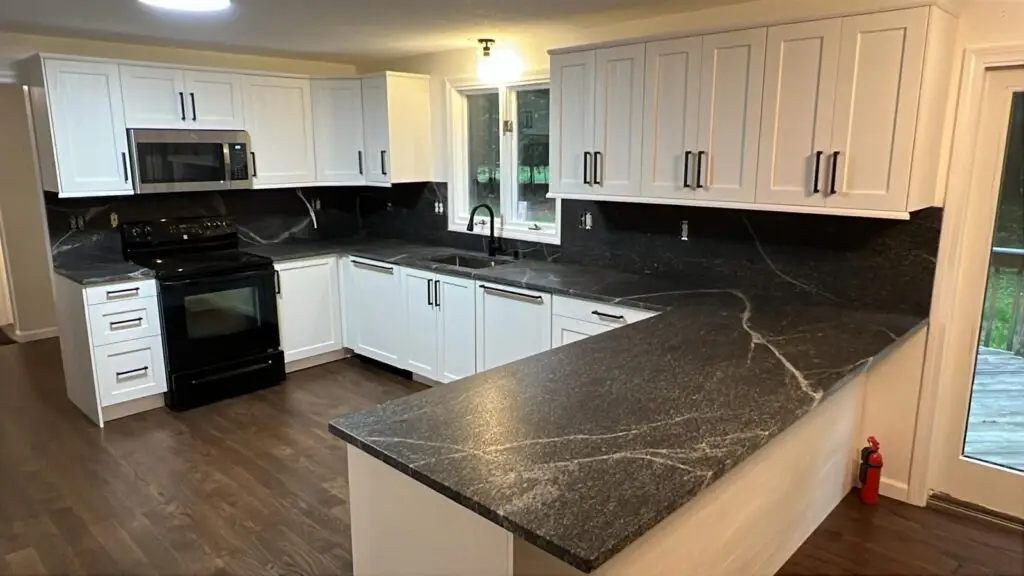
Tools and Materials Needed
Before starting, ensure you have the following essentials:
- Measuring Tools: Tape measure, laser level, and carpenter’s square.
- Cutting Tools: Circular saw (with a diamond blade for stone) or a jigsaw.
- Installation Supplies: Construction adhesive, 100% silicone sealant, and shims.
- Safety Gear: Dust mask, safety glasses, and heavy-duty gloves.
- Support: Sawhorses and extra hands for lifting heavy slabs.
Step-by-Step: How to Install Kitchen Countertops
Step 1 – Measure and Prepare
Confirm that your base cabinets are permanently secured and perfectly level. Use a laser level to check for any dips or high points. Any unevenness in the cabinets can cause stone countertops to crack over time.
Step 2 – Cut the Countertop
Measure twice and cut once. If you are using laminate or butcher block, you can cut these on-site. For Quartz or Granite, cutting must be done in a professional fabrication shop using CNC machines and water jets to prevent chipping and ensure exact dimensions for sinks and cooktops.
Step 3 – Apply Adhesive and Secure
Apply beads of high-quality construction adhesive along the top edges of the base cabinets. Carefully lower the countertop into place. For stone slabs, ensure the weight is evenly distributed across the cabinet frames.
Step 4 – Seal and Finish Edges
Fill the gap between the countertop and the wall (or backsplash) with a bead of silicone caulk to prevent water from seeping behind the cabinets. If your countertop has seams, use a color-matched epoxy to join the sections seamlessly.
Can You Install Kitchen Countertops Yourself?
Whether a DIY approach works depends entirely on the material:
- When DIY Works: Laminate, butcher block, or tile. These materials are lighter, easier to cut with standard power tools, and less expensive if a mistake occurs.
- When It Doesn’t: Quartz, Granite, Quartzite, or Marble. These materials are incredibly heavy (a single slab can weigh over 500 lbs) and require specialized diamond-tipped tools and wet-cutting systems.
- Skill Level Required: Advanced DIY skills are needed for templating and joining seams.
DIY vs. Professional Countertop Installation
| Option | Pros | Cons |
| DIY Installation | Lower labor costs; flexible schedule. | Risk of cracking the slab; visible seams; no warranty. |
| Professional | Precision fit; expert seam joining; heavy lifting handled; guaranteed results. | Higher upfront cost; requires scheduling. |
Common Mistakes When Installing Countertops
- Wrong Measurements: Even being 1/8″ off can result in a countertop that doesn’t fit against the wall or leaves an awkward gap at the stove.
- Uneven Cabinets: Installing heavy stone on unlevel cabinets creates “stress points” that often lead to cracks within the first year.
- Improper Sealing: Failing to seal the sink cutout properly can lead to water damage and mold inside your base cabinets.
- Poor Adhesive Application: Using too much or too little adhesive can cause the countertop to shift or vibrate.
How Long Does Countertop Installation Take?
A professional installation for an average-sized kitchen typically takes 3 to 6 hours once the material has been fabricated. A DIY project, including prep and finishing, can take an entire weekend or longer depending on your experience.
Cost to Install Kitchen Countertops (Labor vs. Materials)
- DIY Cost: You save on labor (typically $30–$60 per hour), but you must pay full price for materials and any specialized tools you need to rent.
- Professional Cost: Installation is often bundled with the fabrication cost. While the upfront price is higher, it includes the “insurance” that if a slab breaks during the process, the pro replaces it—not you.
Best Countertop Materials for DIY Installation
- Laminate: The easiest for DIY; can be cut with standard saws.
- Butcher Block: Medium difficulty; requires wood-working tools and oiling.
- Quartz/Granite/Quartzite: Professional installation only. The risk of injury and material loss is too high for a standard DIY project.
Professional Countertop Installation in Massachusetts
In regions like the North Shore and Greater Boston, home settling is common in historic properties. Professional installers from JRL Granite & Marble use digital templating to account for walls that aren’t perfectly square, ensuring a flawless fit that DIY methods simply cannot match.
FAQs About Installing Kitchen Countertops
Can I install kitchen countertops myself?
Yes, if using laminate or wood. However, for stone surfaces, the weight and complexity make it a task for professionals.
What is the easiest countertop to install?
Laminate is the most DIY-friendly material due to its weight and ease of cutting.
Do countertops need to be glued down?
Yes. Silicone or construction adhesive is used to prevent the heavy slabs from shifting and to provide a flexible bond that accommodates home settling.
How much does countertop installation cost?
Installation labor typically ranges from $10 to $30 per square foot, though this is usually included in the total “installed price” provided by JRL.
Need Help Installing Your Countertops?
Don’t risk your investment on a DIY mistake. At JRL Granite & Marble, we handle everything from digital measurements to the final polish.
- Free Estimate: Know your costs upfront.
- Expert Fabrication: Precision cuts for every sink and corner.
- Stress-Free Installation: Our team handles the heavy lifting and perfect seams.
Contact JRL Granite & Marble today for a professional installation quote!